
The Latest Hospital Digital Marketing Articles
GreyMatters is your hospital digital marketing guide, with articles on hospital digital marketing best practices, trends, updates and more.
Meet Our 2026 John A. Eudes Vision & Excellence Award Winner
This article was written for Greystone.Net by Jessica Levco, a freelance healthcare writer and event strategist.
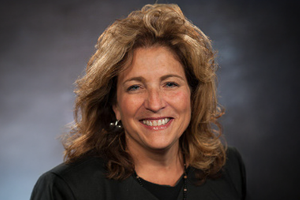
A sign hangs behind Chrisie Scott’s desk at Virtua Health that says, “Everything is figure-outable.” It could pass for generic office decor, except Scott means it literally, and she’s spent 30 years building a career that proves it.
This year, Greystone.Net named Scott, senior vice president and chief marketing officer of Virtua Health, the recipient of the John A. Eudes Vision & Excellence Award. Throughout her career, she has embodied what the award stands for: caring more, risking more, dreaming more and expecting more than others think is wise, safe, practical or possible. She’s well-known in our industry for building engaged, high-performing teams; aligning brands with organizational culture; amplifying the consumer voice; and helping make healthcare and its language more human, accessible and trusted.
“Chrisie Scott has shown us that great marketing starts with listening to patients, communities and the teams doing the work,” says Kathy Divis, president of Greystone.net. “She championed a culture of excellence long before it was fashionable to talk about culture, and she did it by showing up as an authentic leader, day after day.”
Before joining Virtua Health’s executive team in 2018, Scott served as chief marketing officer for Hackensack Meridian Health, where she led the development and launch of its inaugural brand strategy. She spent much of her career at Meridian Health, navigating multiple acquisitions and helping create one of New Jersey’s first truly integrated, consumer-focused health network brands as vice president of marketing, communications, planning and community outreach.
As the past board president of New Jersey Breakthrough T1D (formerly JDRF), she serves as a board member and advocate for accelerating a world without type 1 diabetes. She is a member of the Healthcare Executive Forum, a peer-run, executive-level group that fosters accelerated learning, sharing and professional development in marketing and strategy. She is a featured author in Transformative Leadership: Self-Mastery for the New Voice of Business Success.
Scott was recently honored as one of Ragan’s Top Women in Marketing, Class of 2026, and named a finalist for Gartner’s 2026 Chief Marketing Officer of the Year. She is frequently recognized by Becker’s as a Chief Marketing Officer to Know and has been honored as a Top Woman in Business by NJBIZ and a Brand Builder by Leading Business Women Entrepreneurs and Business Owners.
She earned an MBA in marketing from Fairleigh Dickinson University and a bachelor’s degree in communications from Rowan University.
5 ways to keep healthcare marketing human
As AI reshapes how healthcare markets itself, Scott spends a lot of time thinking about how to make sure our industry stays in touch with our humanity. Here’s how she and her 35-member marketing and communications team are doing that:
- Start with the “why” before you write the story. Before her team writes anything, Scott asks them to answer this question first: What do I want someone to feel after they read this? “There’s somebody vulnerable, confused or overwhelmed on the other end of the story,” Scott says. “I want my team to write in a way that’s going to make things better for them. AI can draft a few sentences and polish things up, but it can’t answer that question for our readers.”
- Fix the language of healthcare. Scott’s team created the Language of Caring guide, about 20 pages and in its second edition. It strips out clinical shorthand and acronyms and replaces them with plain, sensitive language. The guide has been shared with all of the 16,000 employees at Virtua Health, from clinicians to the access center staff answering phones. “Nobody is coming to make the language of healthcare less confusing,” Scott says. “That’s our responsibility as marketers and communicators.”
- Personalize by behavior, not just demographics. Rather than segmenting audiences by age or gender, Scott’s team built behavioral segments, like the “doctor dodger,” someone with so much going on in their life that healthcare keeps slipping down the list, versus the “traditionalist,” who follows a doctor’s instructions step-by-step. Every patient in Virtua Health’s Epic database is tagged with a segment, so the team can talk to people in the most relevant way for them.
- Learn AI together. Scott’s team holds a daily “Morning HUG (Human Understanding Gathering),” where anyone can share something they’re working on, stuck on or have learned. Recently, that included a hands-on session where the team wrote and rewrote AI prompts together and watched the output change in real-time. “There’s no judging or shaming folks that don’t already know something about AI because it’s constantly evolving,” Scott says. “I also want to make sure our team knows that AI isn’t going to replace the human side of what we do. It’s not going to replace our judgment, creativity or curiosity.”
- Build moments that remind your team why the work matters. This past summer, Scott’s department hosted seven interns, and on their last day, Scott held a “light maker” session. Each intern picked a mason jar filled with a string of lights, in whatever color spoke to them, and Scott told them a single light isn’t much on its own, but strung together with other lights, and other people, it becomes something brighter. “Marketing is about making light,” Scott says. “We shine light on science, medicine and the things people can do to take care of themselves and the people they love.”